Best payroll software options for construction companies
Blog
Payroll

A contractor just landed two sought-after contracts, one federally funded and one state funded. Great news! But there’s a problem.
Up to now, the contractor’s payroll system has been working out fine. One crew, one jurisdiction, and no prevailing wage requirements to worry about. Suddenly, they need to manage payroll for crews in multiple states, pay the right prevailing wage rates for federal and state-sponsored jobs, and submit weekly certified payroll reports.
At this point, the existing payroll system hits a breaking point. But should the HR team outsource payroll or manage it in-house?
This guide explores the pros and cons of in-house payroll versus outsourcing to help growing contractors understand the trade-offs. The wrong choice can mean compliance exposure, lost time, or an HR team stretched too thin during a growth phase.
In-house payroll means internal systems and staff manage payroll. At the extreme, it involves running every aspect of payroll completely by hand. More commonly, HR teams use payroll software to streamline the process. Keeping control over payroll while using tools to handle error-prone work is sometimes called “co-sourcing.”
Teams who handle payroll in-house have to manage:
Teams with smaller HR departments or companies taking on more complex projects may have a hard time managing each of these processes by hand. That’s why some turn to outsourcing.
Payroll outsourcing involves offloading some or all of the responsibility of processing payroll to a third-party company such as a professional employee organization (PEO) or payroll software. A contractor might hand over the entire process or outsource some tasks while keeping others in-house.
For example, a contractor might use an outsourced provider to take care of tax filing and certified payroll reporting while keeping time tracking and pay approvals internal. This mixed approach lets HR teams hold onto ultimate control and oversight while still easing the payroll burden.
Giving the bulk of the work to outsourced payroll services isn’t a completely hands-off solution. Outsourcing can reduce compliance risk and significantly lighten the administrative load, but payroll teams typically still need to be involved for quality assurance. Even with a reliable provider, errors occur, and in-house HR remains responsible for catching them before payroll runs.
The amount of oversight might be limited, like sending over timesheets, or more involved, like double-checking that fringe and prevailing wage rates were applied correctly.
Here’s a summary of the main factors that set in-house payroll and outsourced payroll apart.
| In-house payroll | Outsourced payroll | |
| Degree of control | Contractors maintain full control over all processes and data, outsourcing specific functions as needed. | Contractors sacrifice some control in exchange for a reduced administrative workload. |
| Level of involvement | Taking care of more tasks internally means a higher level of involvement is necessary. | The more outsourced tasks, the less involvement required. |
| Compliance | Navigating compliance can be time-consuming and expensive, especially if errors turn up. | Outsourced providers bring compliance expertise, but contractors remain legally liable for errors, regardless of who made them. |
| Scalability | Scaling payroll management for a growing firm may mean hiring more HR team members and revamping existing processes. | Using an external provider can make scaling easier because the provider’s systems absorb the added complexity, but costs can outpace benefits. |
| Integrations | Running payroll internally may require integrating with different platforms, such as accounting software or time-tracking tools. | Integration requirements vary by provider. Some outsourced solutions connect with existing tools; others require manual data transfer or additional middleware. |
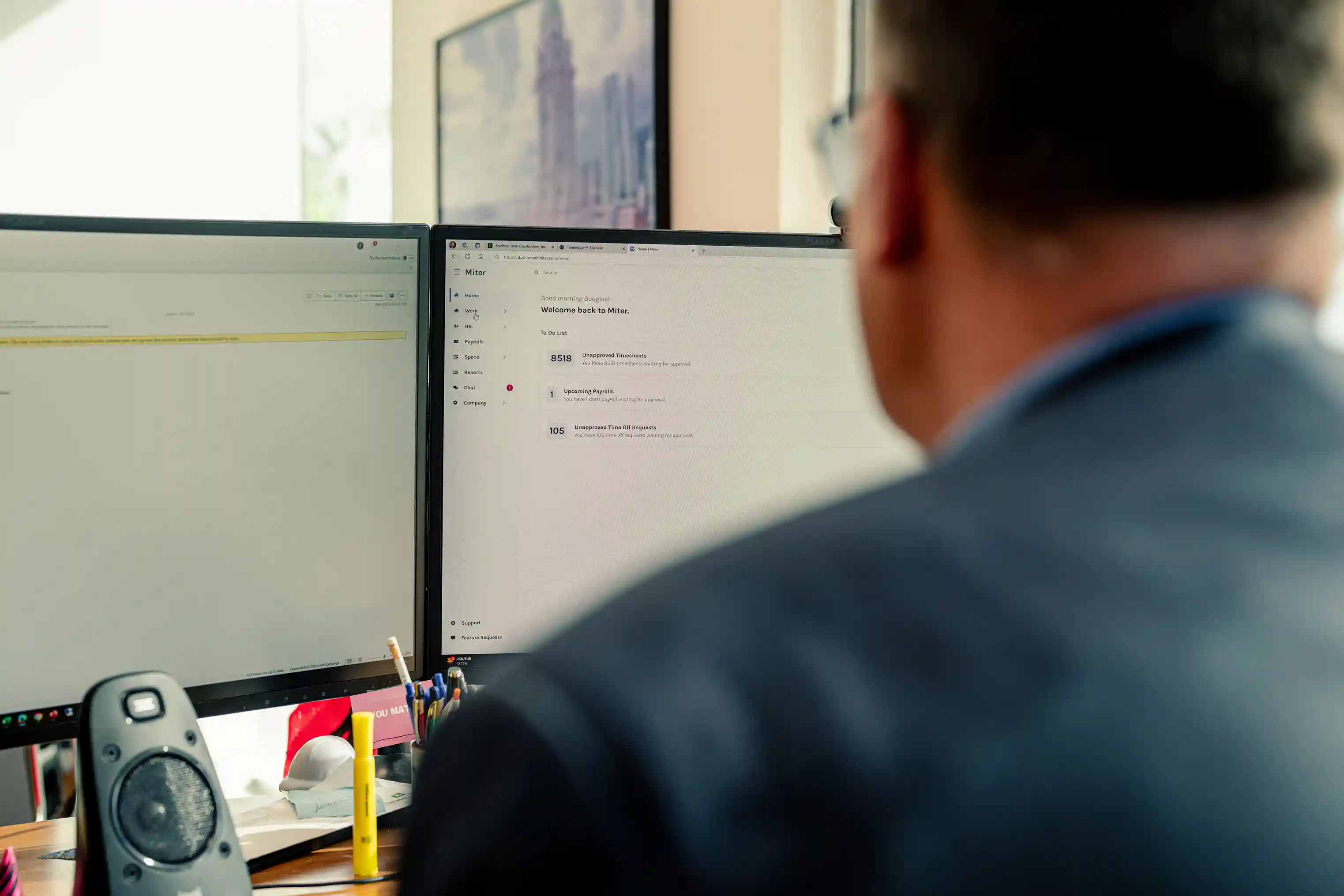
Both in-house and outsourced payroll offer a varying amount of involvement and control. Miter Payroll takes the best from both approaches. HR teams maintain as much control as they need while offloading the most time-consuming and error-prone tasks onto the software.
Why do construction companies consider outsourcing payroll, and what holds them back? Let’s find out by examining the benefits and drawbacks of both approaches.
Contractors don’t have to choose between control and efficiency. Miter Payroll takes the biggest benefits of in-house and outsourced payroll for an approach we like to call co-sourcing.
Co-sourcing enables contractors to automate the most time-consuming and error-prone payroll tasks without sacrificing control. Miter is a full payroll processor, so it handles all the following processes in one system:
On top of that, Miter integrates with ERP tools like Sage Intacct and QuickBooks as well as project management platforms like Procore and BuildOps. Time data can come from Miter or a connected project management tool, and fully burdened labor costs flow from payroll into ERPs for accurate job costing. With Miter in hand, the internal HR team stays in charge, but administering payroll no longer dominates their week.
Consider these factors to find the perfect payroll provider or software to partner with.
The provider should have a perfect track record of handling fundamental payroll tasks such as direct deposits, payroll tax remittance, and garnishments. Check user reviews to see how well the provider handles each of these tasks.
Generic payroll solutions don’t have the infrastructure or experience to handle complex construction workflows. Look for a company or construction-specific payroll software that’s able to manage certified payroll reporting, prevailing wage calculations, and multi-state tax and compliance considerations.
One of the key selling points of outsourcing payroll is saving time. Lacking integrations with ERPs (like Sage and QuickBooks) and project management platforms (like Procore and BuildOps) means your payroll data lives in multiple silos, and an in-house team still has to manually transfer information, wasting time and creating more chances to introduce errors.
Outsourcing payroll doesn’t mean issues will never come up. When something goes wrong, contractors need to know they can get timely support to fix it.
Look for a provider with a model that allows for custom control. HR needs to maintain oversight while still saving time since that’s what makes outsourcing appealing in the first place.
Choosing between in-house and outsourced payroll management doesn’t have to be a one-or-the-other decision.
With Miter Payroll, contractors retain full oversight over payroll while simplifying the tedious and error-prone tasks that drain their resources. Accurate calculations, tax considerations, and compliance and reporting all become a matter of routine. In fact, thousands of contractors use Miter to reduce their payroll workload, some by 90% or more.