Employee retention in the construction industry: Metrics and tips
Blog
HR


Survey Responses: 250+
Questions: 115
Senior Decision-Makers: 75%+
Contractors on Miter: 1,500+
Miter is a next-generation people & field platform built specifically for construction. We work with 1,500+ specialty contractors and GCs across all 50 states. These customers process payroll in Miter for 100,000+ field workers every week across union, prevailing wage, and multi-state environments. This unique vantage point gives us an unusually close view of what employee experience looks like on the ground.
In 2026, we launched a comprehensive survey of construction leaders including CEOs, CFOs, Controllers, HR executives, and other senior leaders. These 115 questions spanned across employee experience, retention programs, turnover economics, and technology. More than 250 responded. This report presents what we learned, framed around the argument that has emerged most clearly from our work: the firms that will win the next decade are investing in winning the talent war today.
The numbers in this report come from real contractors, in their own words. The analysis is ours.
American construction is entering one of the most significant building cycles in a generation. Since 2021, more than $4 trillion in federal investment has been committed to infrastructure, semiconductor manufacturing, clean energy, and AI data centers. From the Infrastructure Investment and Jobs Act to CHIPS, the Inflation Reduction Act, Stargate, and the One Big Beautiful Bill, the projects are coming, and the money is real.
The workforce shortage is just as real. Consider what the data shows:
20%
of construction workers are aged 55 or older
92%
of construction firms struggle to find qualified workers
~454,000
additional workers needed industry wide just to meet current projected demand
45%
of firms report project delays directly caused by labor shortages
Source: SHRM, industry studies, Miter analysis
There are numerous programs and initiatives in flight to combat the decline in skill trade employment, but relief is unlikely to come anytime soon. The demand for skilled labor will continue to rise and unless firms can perfect their recruiting, retention, and development programs, they are likely to operate in a world dominated by project delays,limited growth, and constant uncertainty. The firms that emerge from the next decade as clear winners will be the ones who invested heavily in their most important asset: their people.
Before we talk about employee experience, we need to talk about what it’s actually building toward. The concept is straightforward: talent density.
Talent density is the percentage of your workforce performing at a high level. Simply, the share of colleagues who genuinely impress you. You can feel it in an organization. It shows up as foremen who can run a job without daily escalation, field crews that catch their own mistakes before the PM does, new hires who ramp in weeks instead of months, office staff who close the books on time, and employee referrals who consistently turn out to be top performers.
Talent density isn’t a soft concept. It has hard business consequences:
Talent density is a virtuous (or vicious) cycle. Companies with strong teams have a knack for attracting increasingly strong talent. No one wants to feel like they are joining a team where they are the smartest, most talented, or hardest working person in the room. Strong employees want to be inspired by the people around them. Talent like this ramps quickly and builds an environment and culture that continues to recruit even stronger talent. This flywheel is extremely powerful and is immediately apparent to candidates as early as their first interview.
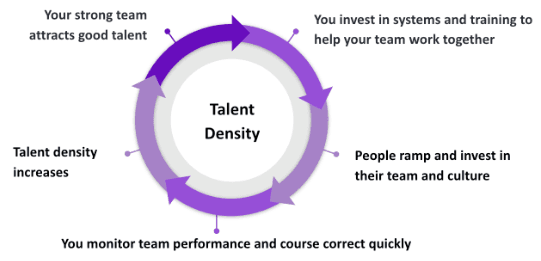
Conversely, in an environment where talent density is low, the reverse happens. Your best people start to realize they are carrying the majority of the weight and there is not a continuous infusion of talented people who push them to be their best. This is a world where mediocrity reins supreme and your best people start to leave. The cascading effect looks like recruiters replacing referrals, new hires taking months to ramp, and managers fighting fires instead of planning for the future.
Most problems that contractors wrestle with such as missed schedules, rework, safety incidents, project delays, overtime blowouts, customer relationship strain trace back to people. Which means most of your competitive advantage does too.
So how do you build talent density? The path runs through employee experience.
Employee experience (EX) is not a vague concept about company culture or ping-pong tables. In construction, it has a precise meaning: whether a person can show up to a jobsite, day after day, and do their best work. That means they:
Employee experience is the lever that moves talent density in both directions. When EX is strong, A-players stay and bring others. Referrals dominate your hiring channel. Turnover drops below the industry average. Margins expand as the team compounds stronger. When EX is weak, the opposite unfolds: A-players leave, B-players fill the void, and the firm gradually declines even as it appears busy.
Here is the critical insight from our survey data: most contractors have a general sense that employee experience matters, but very few have translated that belief into a systematic set of programs. That gap is where competitive advantage is won or lost.
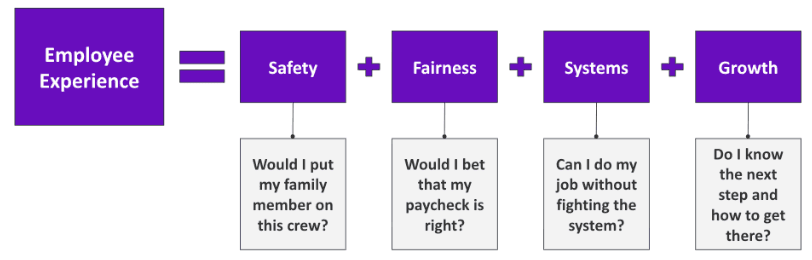
Based on what we’ve learned across 1,500+ contractors and this year’s survey, employee experience in construction is driven by four compounding dimensions. Think of them as layers or Maslow’s hierarchy of needs, each one must be solid before the next fully delivers its value.
🦺
No Injuries
The foundation. Workers who don’t trust that their employer takes safety seriously are already halfway out the door. Great safety programs go beyond OSHA minimums, formal curricula, a named owner, site specific hazard reviews, and visible standards from day one.
⚖️
No Pay Drama
Nothing erodes trust faster than a paycheck that doesn’t add up. In construction, with prevailing wage, union rules, per diems, and multi state OT, payroll accuracy is hard. But it’s not optional. Fairness also means real benefits and a real channel for employees to be heard.
⚙️
No Admin Pain
Clunky onboarding, paper based processes, certifications tracked on spreadsheets, these frictions accumulate and send a signal: we don’t value your time. Strong systems means structured onboarding, digital tooling, and development programs that don’t quietly leak away.
📈
No Dead Ends
Once the basics are solid, employees ask one question: is there a future for me here? That means mentors, defined advancement paths, and structured feedback. This is where most contractors have the largest gap, and the largest opportunity.
EX is an investment. Turnover is the tax you pay when you skip it.
Every time someone leaves, you pay both visible and invisible costs. The visible ones show up on the P&L: separation processing, recruiting ads, agency fees, background checks, drug tests, certification screenings, interview time across HR and foremen, onboarding materials, and orientation hours. The invisible ones are often larger: the role sits vacant and production slows, the new hire is below full productivity for weeks, there is elevated quality and safety risk during ramp, and the team’s morale and coordination take a hit.
| Role | Replacement Cost | Example |
|---|---|---|
| Hourly Worker | 16 to 20% of salary | ~$8,300 at $50K/year |
| Project Manager | 20 to 40% of salary | ~$28,000 at $70K/year |
| Superintendent | 30 to 110% of salary | $45,000 to $155,000 at $150K/year |
Source: SHRM, industry studies, Miter analysis
A 100-person contractor with 30% annual turnover is spending between $250,000 and $500,000 per year replacing people. That number is likely a floor, not a ceiling. It uses a conservative 20% replacement cost baseline and doesn’t capture the indirect productivity and morale drag.
Our survey data fills in the granular picture by employee group. Replacing senior team members becomes more and more expensive, which underscores the importance of retaining and developing the next generation of talent:
| Metric | Laborer | Foreman | Supervisor |
|---|---|---|---|
| Turnover Rate | 14% | 7% | 4% |
| Training Hours (new hire) | 265 hrs | 285 hrs | 314 hrs |
| Recruiter Fees | $1,635 | $3,627 | $9,179 |
| Replacement Timeline | 4.4 weeks | 8.3 weeks | 10.5 weeks |
| Extra Vacancy Cost | $923/week | $2,539/week | $2,732/week |
Source: Miter 2026 Employee Experience Survey
These aren’t abstract numbers. They are dollars leaving your business every time a good person walks out the door. The question is: compared to what you’re paying in turnover, what would a meaningful investment in employee experience actually cost? For most contractors, the answer is: less. Often, much less.
Across our survey, eight specific programs emerged as the concrete building blocks of a strong employee experience in construction. They map onto the four dimensions, Safety, Fairness, Systems, and Growth, and each one is measurable, ownable, and improvable. The data tells a consistent story: most contractors have the program in name, but far fewer have assigned real ownership to it.
Nearly 1 in 5 contractors told us they’re simply not sure which retention strategies work in general.
Safety · 77% have a program · 35% have a named owner
Safety training is the most widely adopted of the eight programs, but adoption alone isn’t the win. The gap between 77% with a program and 35% with a named owner is where safety initiatives die a slow death. A formal curriculum with a regular cadence, site-specific hazard reviews, and a real owner with field accountability is the standard to aim for.
Fairness · 91% offer benefits · 21% have a dedicated administrator
Benefits are nearly universal—91% of contractors offer them. But only 21% have someone who owns the benefits function. The result: enrollment confusion, low utilization, and investment that never lands. A great benefits package that employees can’t access or don’t understand is a wasted competitive advantage. Assign an owner. Make sure employees can actually use what you’re offering.
Fairness · 86% have a channel · 19% use software to manage it
86% of contractors say their employees have a channel to raise concerns. Only 19% have any software supporting it. That gap between a stated open door and a structured process is where most feedback quietly disappears. Employees notice when their input goes nowhere. A real voice channel means collecting input systematically, routing it to the right people, and closing the loop.
Systems · 75% have a program · 31% track it with software
Three-quarters of contractors invest in skills development, but only 31% track it through software. Without a system, certifications lapse, training gaps compound, and the investment quietly leaks away. The firms getting a real return on development are the ones who know who has been trained, when, and what’s next.
Systems · 70% have a program · 26% have a named owner
The first 90 days are when retention is most fragile. Research consistently shows that structured onboarding can boost first-year retention by up to 60%. Yet only 26% of contractors have a named owner accountable for the new-hire experience. An unnamed program is a program nobody feels responsible to execute. A great onboarding program isn’t paperwork, it’s the answer to “why did I make the right call joining this company.”
Growth · 30% have a program · 38% with 4+ rating (1-5 scale)
Construction is an industry built on apprenticeship and yet only 30% of contractors have formalized mentorship. This is the easiest Growth program to start and one of the highest-impact. Assigning a senior employee to a new hire for the first six months costs almost nothing and returns significant retention and ramp-speed dividends.
Growth · 32% have defined paths · 49% with 4+ rating (1-5 scale)
Only 32% of contractors have defined advancement paths despite this being one of the most consistent answers employees give when asked why they left a company. A career ladder doesn’t need to be complex. It needs to answer: “Where can I go from here, and what does it take to get there?” Firms that can answer that question clearly have a retention advantage most of their competitors don’t.
Growth · 31% do structured feedback · 40% use software to manage
Only 31% of contractors collect feedback from employees on a consistent, structured basis. For most, feedback is informal, infrequent, and untracked. That means managers don’t know what’s working, employees don’t feel heard, and problems compound silently until they become departures. A regular feedback cadence, even a simple quarterly check-in, builds the information loop that makes every other EX program better.
| Category | Program | Adoption |
|---|---|---|
| Safety | Safety | 77% |
| Fairness | Benefits | 92% |
| Voice | 86% | |
| Systems | Development | 75% |
| Onboarding | 70% | |
| Growth | Mentorship | 30% |
| Advancement | 32% | |
| Feedback | 31% |
The most common question we hear from contractors who understand this argument is: where do I even begin? Here is a practical three-step process that works whether you’re starting from scratch or trying to close specific gaps.
Before deciding where to invest, understand what you’re currently spending. Use this basic formula to size your approximate annual turnover cost:
Headcount × Turnover Rate × Avg. Salary × 20%
A 100-person firm with 30% turnover and a $55,000 average salary is spending roughly $330,000 per year on replacements even before accounting for indirect costs. That number tends to motivate the conversation in ways that theory alone cannot.
Once you have a basic understanding of your turnover tax, you can begin to refine your model to include more granular pieces (training hours, time to replace, recruiter fees, etc.).
Run through the eight programs above and honestly assess where you stand. For each one, ask a few questions:
For most contractors, the Safety and Fairness rows will be mostly green. The Growth row will be mostly red. That gap is your highest return opportunity. Start there.
No amount of external data replaces what your own people can tell you.
Identify three recent hires and ask them directly:
Identify three longer tenured team members and ask them:
The answers will be specific, actionable, and often surprising. They will also demonstrate to your team that you are paying attention, which is itself an element of employee experience.
The #1 tech frustration reported by contractors in our survey? Too many manual workarounds, which was cited by 26% of respondents.
Employee experience is not a program. It’s a compounding bet on the quality of your team over time.
The firms that invest in it build workforces that attract better talent, ramp faster, make fewer mistakes, and create the kind of reputation that makes recruiting easier every year. The firms that treat it as overhead build workforces that gradually weaken, even as those firms stay busy.
The next decade of construction will demand extraordinary things from contractors. The infrastructure investment cycle is real. The labor shortage is real. The window to build talent density before the competition tightens and labor becomes even scarcer is open right now.
The firms who will win are already building a world-class employee experience. Do you need to catch up?