Inside Miter Sales Academy: Four days of onboarding in NYC

My onboarding at Miter was Tobin, our co-founder, and me in a WeWork in Austin, trying to set up Salesforce for the first time. There was no training calendar. No discovery process. No demo path. Just two people clicking through setup screens and figuring it out as we went. Or trying to…
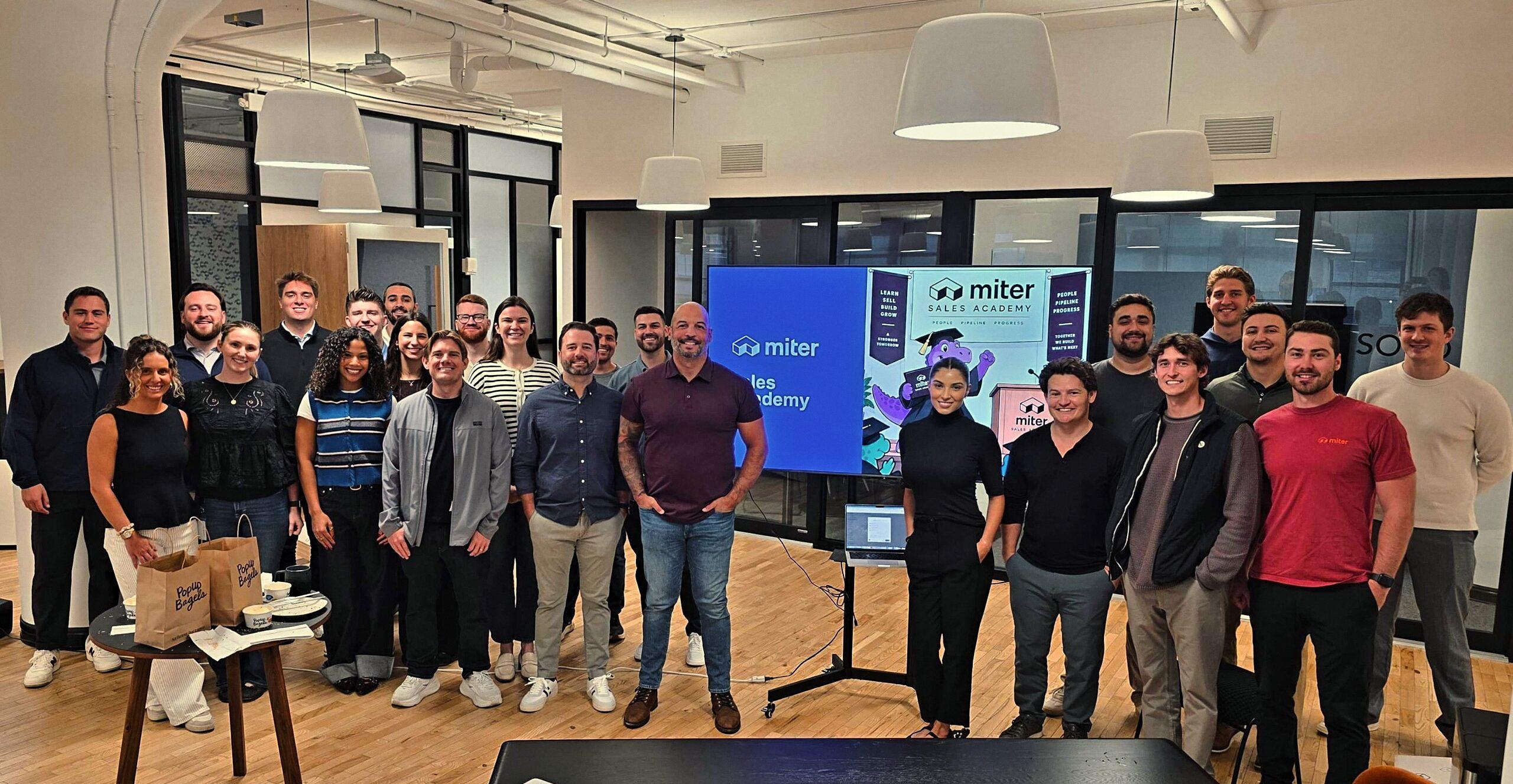
On Monday, September 21, ten new AEs walked into our NYC office for the first ever Miter Sales Academy. Well… most of them walked in. A few spent their first morning stuck in the lobby, messaging the Slack channel for someone to come down and let them up, because we hadn’t sorted out badges yet. Not quite the polished welcome I had pictured, but it felt about right for a first run.
I want to share how we got from that WeWork to that lobby, what we built along the way, and what we learned running it for the first time.
It takes a village to raise a Mitosaur
For a long time, onboarding at Miter ran on sheer will. Reps like Adam Greene, Alexia Katzen and Tyler Chandler got up to speed by sitting in on every call they could, spending countless hours with our sales leaders (and asking a truly heroic number of questions) and teaching themselves how a contractor actually runs payroll. They cared about their craft and about our customers, and it showed.
That last part is harder than it sounds. A mid-size electrical contractor might have union and non-union crews working the same week, with fringe benefits that change by trade, by local, and by job. If one of those jobs is publicly funded, they owe a certified payroll report on it. Our reps need to understand all of that well enough to walk a controller through it, and that controller has often been doing it by hand for 20 years.
To be fair to everyone involved, it worked because those reps were exceptional, not because we had a great system. How quickly you ramped depended a lot on who you happened to sit next to and how much time your manager had that week. That’s manageable when the team is small. It doesn’t hold up when ten reps are ramping at the same time… and as Tobin likes to remind us, we can’t scale heroics. It takes a village to raise a Mitosaur, and we needed to give that village a plan.
What we built
So why now? Mostly because the business stopped waiting for us. We crossed 2,000 contractors on Miter, and the ones who started with payroll keep coming back asking us to run more of their business: timesheets and dailies from the field, onboarding and certs, cards and spend. Every one of those asks is a new conversation a rep has to be ready for, and that’s about as clear a signal of product market fit as you get.
For an AE, that changes the job in the best way. A few years ago we were selling payroll. Today a rep walks in with HCM, FieldOps and Spend, so the same contractor turns into a much bigger deal, and the conversation goes from the payroll manager to the controller, the ops lead and often the owner. The flywheel is picking up speed, too. Happy customers refer their peers, partners walk prospects over to our booth at trade shows, and every so often a CFO who ran Miter at their last company tells their new team they aren’t evaluating anything else.
And there’s a lot of ground left to cover. Construction is one of the biggest industries in the country, and it’s still wildly underserved by software. We regularly meet contractors with hundreds of employees running payroll on QuickBooks, paper timecards and a spreadsheet nobody wants to touch. Our territories are big and wide open, and right now there’s more demand out there than we have reps to work it. We need more people in seats to help harvest it, and those people deserve to understand a contractor’s world on day one, not month six… which meant we couldn’t keep onboarding on sheer will.
We started by writing it all down. None of it is flashy, and that’s kind of the point. Today every new seller gets the same first month, built around four pieces:
- Two weeks in our LMS. Miter sells a learning management system (LMS)to contractors, so it felt right to use it ourselves. In their first two weeks, new hires work through training from Miter leaders on Construction 101, Miter 101, our customers and partners, and each of our core modules across HCM, FieldOps and Spend.
- An onboarding buddy. Every new rep is paired with an experienced AE who meets with them weekly, jumps on their first calls to help run them, and is there for all the in-the-weeds questions that never make it into an SOP.
- Time with their manager. Structured training, weekly 1:1s, mock calls, and a lot of feedback before anyone takes their first live call.
- Demo certification. We broke the product into small sections, and each AE records themselves demoing one piece at a time. They get feedback on every recording, so by the time they’re in front of a prospect they’ve already walked through the whole product.
Two weekly sessions keep everyone honest:
- Punchlist. All of our AEs and SDRs get together each week, pick three or four real calls and review them live as a team. We talk through what we’re hearing in the market, what’s working and what we should change in our messaging. (In construction, a punch list is the list of open items a GC walks through before a job closes out, so the name felt right.)
- Demo Dawgs. Our weekly AE enablement session, covering demo best practices, sales process, product updates and rollouts, negotiation, and the competitive landscape. The name comes from the simple fact that all our sellers are dawgs (this is not up for debate).
Four days in NYC
The LMS gives reps the foundation, and Sales Academy is where they put it to work. It’s a week of in-person training in our NYC office for new hires in their first month. For our first cohort, we brought in every AE who was still ramping. Jake Sackstein built the agenda, chased everyone down for pre-work, and ran the room all week.
Before anyone arrived, each rep set up their own Miter demo environment using a seeding tool that Spencer Semple on our team built (in about 20 to 30 minutes, if you followed the instructions). We spent the next four days working inside those environments, and each day ended with a group demo led by the new reps themselves:
| Day | What we covered | How the day ended |
|---|---|---|
| Monday | Construction 101 and our ICP, Miter overview and integrations, competitive landscape, then three hours hands-on in HR: profiles, onboarding, certs, crew views | Trainee-led HR demo |
| Tuesday | FieldOps: clock in and out, kiosk mode, timesheet approvals, Equipment & product tracking, safety checklists | Trainee-led FieldOps demo |
| Wednesday | Payroll: pay rate groups, approving dailies into payroll, a full payroll run. Then live dials, then proposals, pricing, and objection handling | Trainee-led Payroll demo |
| Thursday | Spend, negotiation, launch, and support | Capstone demos for a panel of judges |
On Thursday afternoon we split into five pairs for the capstone. Every pair got the same prospect scenario and ran it start to finish for a panel of judges, from discovery through demo. Every group was impressive, and you could tell how much work people had put in over the week. Jack Chace and John Morris took home top demo and $100 each. Jack later said he knew they had won after they “definitely one call closed me”, which I’m choosing not to comment on.
The part I’ll remember most happened at the end of Day 4. By then, reps were volunteering to run the group demos instead of waiting to get picked, and the comments on the way out told us the week had done its job. One rep said, “I can’t wait to hit the phones next week.” Another told us they were “feeling dangerous.” And one said, “This is so much more investment in onboarding than I had at my previous company.” That last one stuck with me, because it’s exactly the gap we set out to close.
What didn’t go to plan
Like any first run, not everything went smoothly. We originally planned for five days and then cut Friday about a month out, after some reps had already booked their travel. We also happened to pick the same week as the UN General Assembly, so hotels near the office were booked up and the closest options were marketed as hostels. So we had plenty of long walks back to the financial district hotels. Without badges, most mornings started with someone in the lobby asking Slack to be let up. And the office temperature swung between hot and freezing all week, which Ashley Noble on our NYC team pointed out was pretty good practice for building up character to handle prospect objections.
We also pulled ten reps and a good part of our sales leadership off the phones during the last full week of Q3, which meant giving up selling time at the end of an important quarter. That being said, it ended up being our largest month & quarter ever capped off with announcing our Series B!
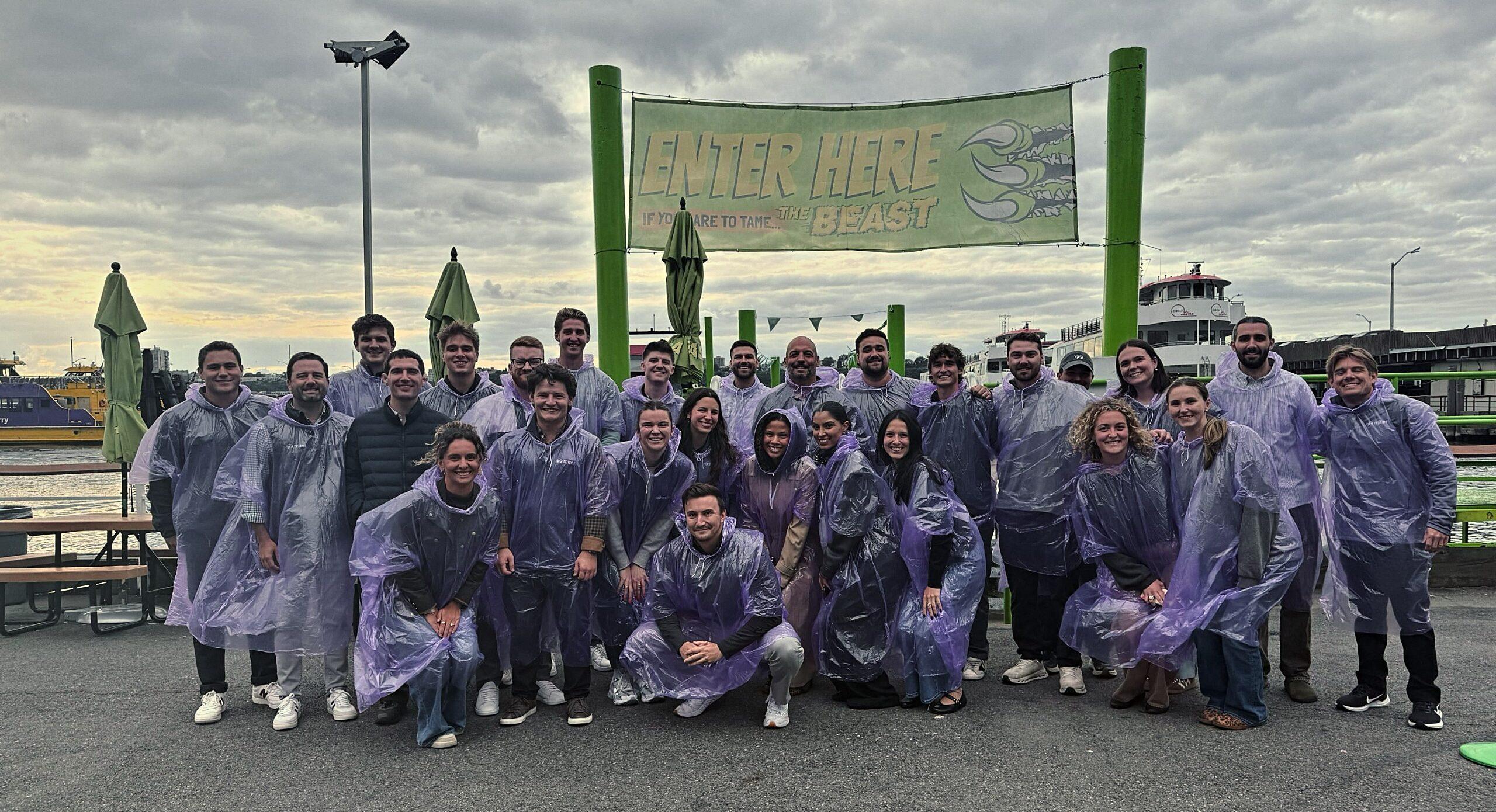
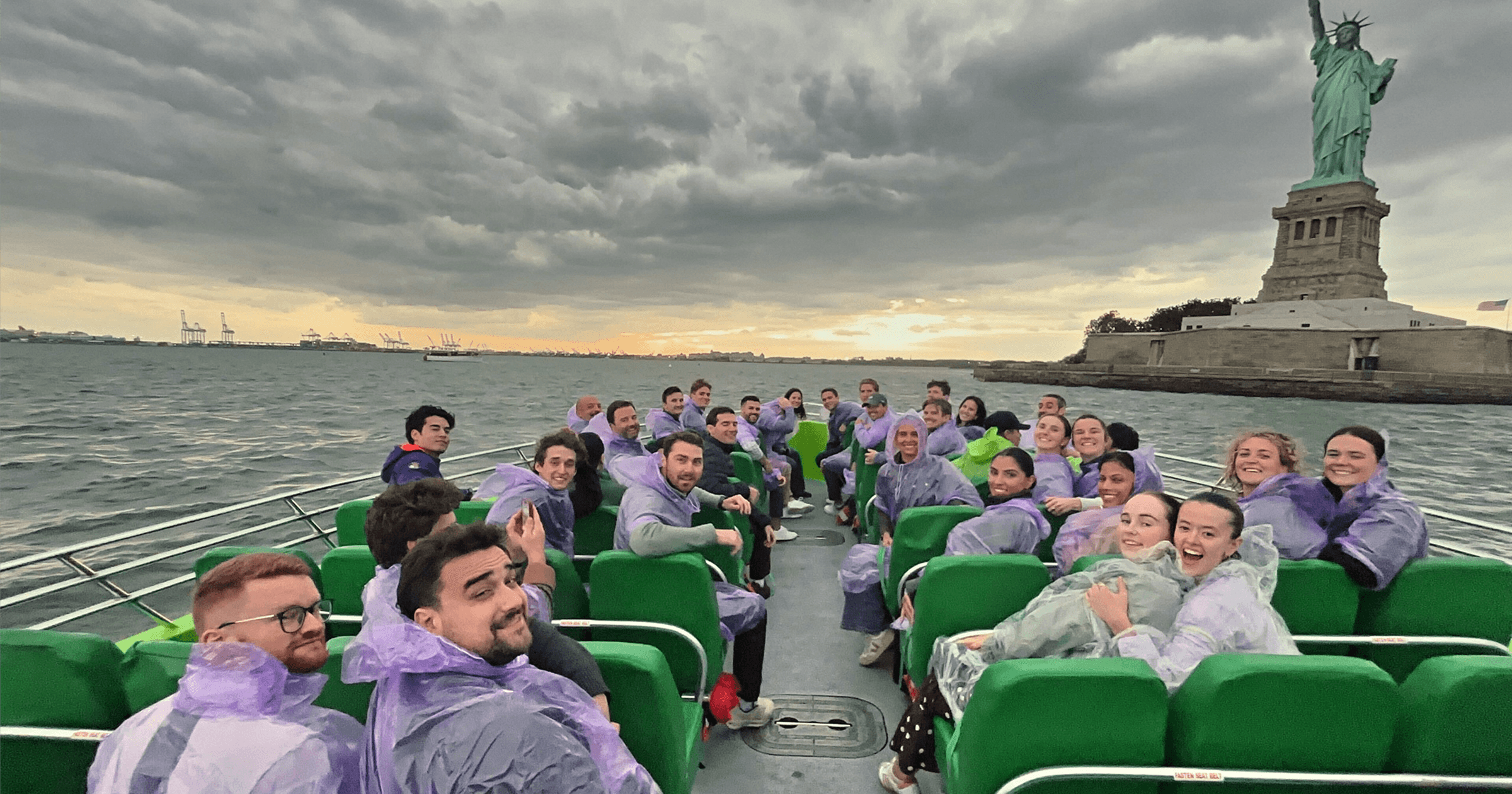
On Tuesday night we handed out ponchos, left our bags at the office and walked over to Pier 83 to board the BEAST, a speedboat that runs down the Hudson at up to 45 mph, past Chelsea and the Financial District, out to the Statue of Liberty and back. Grant had asked for the splash zone back in August, and it turned out the whole boat was the splash zone. Nothing like the taste of the Hudson in September!
The rest of the week ran on a lot of coffee, a few happy hours, a 7am SoulCycle class for those brave enough (thank you Catie Kiernan for rallying the troops), and long dinners where the conversation about deals and territories kept going well past dessert. Those dinners were some of my favorite parts of the week. They’re where a new rep figures out which teammate to call the first time a prospect asks them something they’ve never heard before.
What’s next
It’s been a long road from two people setting up Salesforce in a WeWork to ten new reps running full sales cycles in front of a panel of judges in their first month. None of it happened by accident. Jake, Chase, Kelan, Alexa, Catherine, Ashley, Claudia and a lot of other Mitosaurs gave up real time (during the last full week of the quarter, no less) to teach, judge, plan and herd us around New York. Thank you. We’re already taking what we learned into planning cohort two.
And Sales Academy is only one piece. The whole GTM team (and beyond) is growing to support the people carrying a bag at Miter. We’re adding enablement so every cohort gets a better week than the last. Marketing is investing to put more contractors in front of our reps. Product keeps shipping the things customers ask us for, which gives AEs more to sell and more reasons to win. And RevOps is building the systems and territories so reps can spend their time selling instead of wrestling with Salesforce (a problem I know a little something about).
Now picture what this looks like when it isn’t ten reps in a room, but 20, 50 or 100 in a quarter. That’s the version of Sales Academy we’re building toward: the same hands-on week, the same buddies, the same long dinners, just with a lot more chairs at the table. Construction is too big and too underserved for us to stay small, and every AE who walks out of that week ready to sell means another contractor who finally gets software built for the way they actually work.
At Miter we say it’s still Day 1, there’s arguably more wood to chop now than ever before. If you’re a seller who gives a damn about the craft and about the contractors you’d be selling to, we’re hiring, and we’d love to talk with you.