
OSHA 300 log requirements for construction companies
Blog
Safety
Workforce compliance

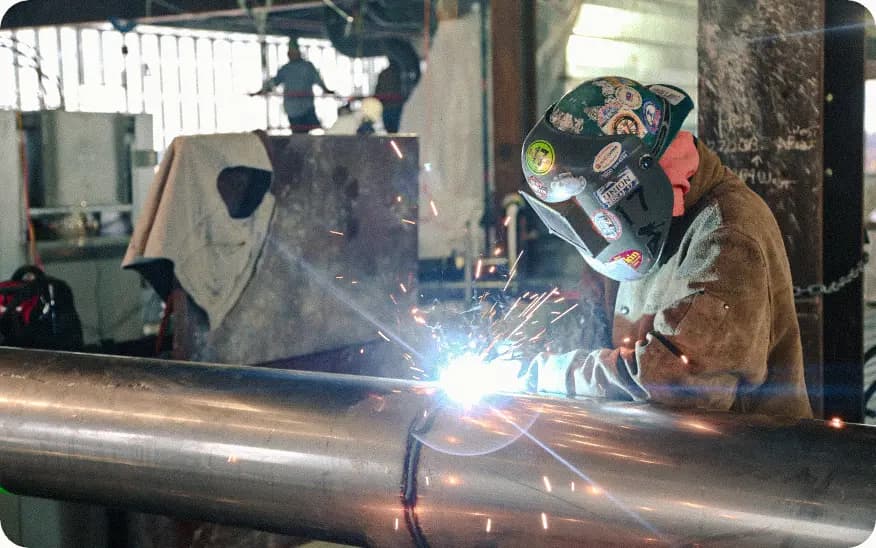
Safety performance directly affects a construction company’s profitability and reputation. Organizations closely track and quantify safety through specific metrics, and one of the most widely recognized indicators is the total recordable incident rate (TRIR). This reflects how many injuries and illnesses occur within a company each year.
Contractors evaluate TRIR during subcontractor prequalification, insurance providers rely on it when assessing risk and setting workers’ comp premiums, and regulatory agencies like OSHA use it to determine inspection priorities. Organizations must track and sustain these numbers to maintain affordable insurance rates and secure high-quality jobs.
This guide outlines what qualifies as a recordable incident under OSHA rules and how to calculate TRIR step by step.
TRIR measures the number of OSHA recordable workplace safety incidents that occur at a construction company per 100 full-time workers over a 12-month period. To make comparisons consistent across companies of different workforce sizes, OSHA uses a standard baseline of 200,000 hours to calculate TRIR. This number reflects total hours worked by 100 employees working 40 hours per week for 50 weeks in a year.
The TRIR safety metric doesn’t predict future risk. It simply accounts for recorded incidents, measuring volume and frequency. Companies and regulators often review it alongside the Days Away, Restricted, or Transferred (DART) rate, which assesses the severity of incidents. Together, TRIR and DART paint a picture both of how often injuries and illnesses occur and how severe they are.
OSHA’s recordkeeping rules and incident recording criteria determine what injuries and illnesses belong on OSHA’s Log of Work-Related Injuries and Illnesses. Here are the events that count toward the TRIR safety calculation.
Contractors have to record any death caused by work activities, regardless of whether the incident occurs on-site or off-site. Timing doesn’t matter, so a fatality that occurs days or weeks after an incident still qualifies if the original injury was the cause.
OSHA draws a clear line between first aid and medical treatment. Contractors must report any case that necessitates treatment in excess of basic first aid, which includes simple actions like cleaning wounds, applying bandages, or using non-prescription medications. Medical treatment includes more advanced care, such as:
Employers have to record whenever a worker loses consciousness on a jobsite. This counts as a TRIR injury even if the worker regains consciousness quickly and resumes normal work activities with no medical treatment apart from first aid.
Any injury becomes recordable when it prevents an employee from reporting to work for one or more full days. The count starts the day after the injury takes place, and employers must track each subsequent missed day to capture the full impact.
Employers have to log any injury that limits a worker’s ability to complete regular job duties or forces a reassignment to another role. A supervisor or medical provider may set these restrictions. The incident qualifies as recordable when the limitation continues beyond the day of the incident.
A licensed healthcare provider may identify a work-related condition even when no single incident caused it. Contractors are required to log certain diagnoses if a provider connects them to workplace exposure.
Examples include:
The TRIR formula converts raw data into a single rate:
TRIR = (Total Recordable Incidents x 200,000) ÷ Total Hours Worked
Follow the steps below to find the total recordable incidents and calculate TRIR.
Review OSHA’s Log of Work-Related Injuries and Illnesses and total all recordable cases that occurred over the last 12 months. Include every incident that took place on an active jobsite or involved a worker that was under company supervision. Employers also account for temporary labor that’s under their direct supervision. The total number of all incidents becomes the numerator in the rate calculation.
Next, add all hours worked over the same 12-month window by hourly, salaried, and applicable temporary workers. Only include hours actually worked, leaving out sick leave and paid time off. This value forms the exposure base for the calculation.
Insert the totals into the formula to calculate TRIR.
Example scenario:
A contractor reports eight recordable incidents and 400,000 hours worked over the year.
Calculation:
TRIR = (8 x 200,000) 400,000 = 1,600,000 ÷ 400,000 = 4.0
This results in a TRIR rate of 4, which means a company had four recordable injuries per 100 full-time employees.
Here are the three most common errors that can distort TRIR results:
TRIR varies across construction segments. Leaders compare numbers against North American Industry Classification System (NAICS) code peers rather than a single universal target.
The construction industry (NAICS 23) typically reports TRIR around 2.2 to 2.3, but rates vary widely by trade. Specialty trades run highest, with roofing and framing among the most hazardous, while heavy and civil work usually comes in below the industry average. Residential and finishing trades also tend to report lower rates. For more appropriate comparisons, contractors should compare their TRIR to their unique NAICS sub-codes instead of using the industry average.
Here’s how different TRIR rates affect an organization’s reputation.
A TRIR under 1.0 indicates strong control over workplace safety hazards and can give contractors a significant edge over other firms in prequalification. Many project owners view sub-1.0 performance as a sign of a strong safety culture and disciplined safety management.
A TRIR above the industry-wide average suggests elevated exposure to jobsite safety risks. That level often leads to increased OSHA scrutiny and higher insurance premiums. Some prequalification systems also apply fixed TRIR thresholds that automatically exclude contractors with higher rates.
A zero TRIR may look like a perfect record at first glance, but it often raises suspicions about purposeful underreporting. The construction industry involves inherent safety risks, and even with strong safety practices in place, accidents and injuries are bound to happen occasionally. Accurate OSHA recordkeeping carries more weight, and most parties prefer to see an extensive, defensible log than a zero or near-zero rate.
A contractor’s TRIR can impact cost, access to work, and regulatory attention across construction operations. Here are the main areas TRIR affects:
Reducing TRIR generally requires more than a single initiative. Teams need consistent execution across job sites and supervisors to yield a meaningful difference. Here are a few strategies.
Workers often encounter hazards on a jobsite before an actual incident takes place. Near-miss reporting helps employers catch these risks early. When workers feel comfortable reporting close calls, safety leaders get valuable insights into risk patterns, which helps prevent recordable injuries before they happen.
Firms that rely on a single company-wide TRIR aren’t seeing the whole story. Breaking down incident rates by project, crew, and supervisor highlights concentration points. This creates a system of accountability and ensures leaders apply corrective actions in the right directions.
Relying on annual reports alone delays the response to trends. With quarterly or monthly TRIR reviews and internal construction safety audits, teams can identify recurring problems early and take proactive steps to correct hazards. Early action prevents small issues from turning into multiple recordable events.
Holding short, focused safety meetings helps crews stay aware of risks and encourages safe behaviors on jobsites. These talks should happen regardless of whether a recent incident occurred or not, but they’re especially critical after an accident or near miss. In these situations, targeted retraining can help address the root cause and prevent the incident from recurring.
When contractors rely on separate systems for time tracking and incident recording, it’s much harder to identify which injuries or illnesses are tied to which hours and jobsites. Integrated systems connect data in real time, producing accurate, timely TRIR safety metrics across all workers on active projects.
Calculating TRIR relies on accurate time and incident data. Most contractors struggle to identify trends in safety hazards and incidents because they use payroll systems for time tracking and paper forms or spreadsheets to record injuries and illnesses. Reconciling this information manually slows down analysis and increases the risk of human error, but integrated systems bridge the gap.
Miter brings payroll, time tracking, HR, and field operations together, so the hours worked that drive TRIR already live in the same system as your incident log. There’s nothing to reconcile and nothing to calculate by hand: Miter computes TRIR and DART automatically from approved timesheets.
The Miter Safety dashboard displays recordables, days since the most recent lost-time incident, and a 24-month trend against the BLS construction benchmark. This gives contractors clear, current insights without building separate reports from scratch.